
Technical Guide
Surface-energy transfer and pin printing
Contact Pin Dispensing: Contact-based spot transfer
Contact pin microdispensing transfers defined liquid volumes from a loaded pin to a target surface. Instead of ejecting a droplet, the method uses controlled contact, surface energy and wetting behaviour to create reproducible spots in the picoliter-to-nanoliter range.
This technical guide explains the physical principle behind contact-based pin dispensing, from capillary and blunt-end pin geometry to liquid bridge formation, surface wettability, spot transfer and high-density parallel printing.
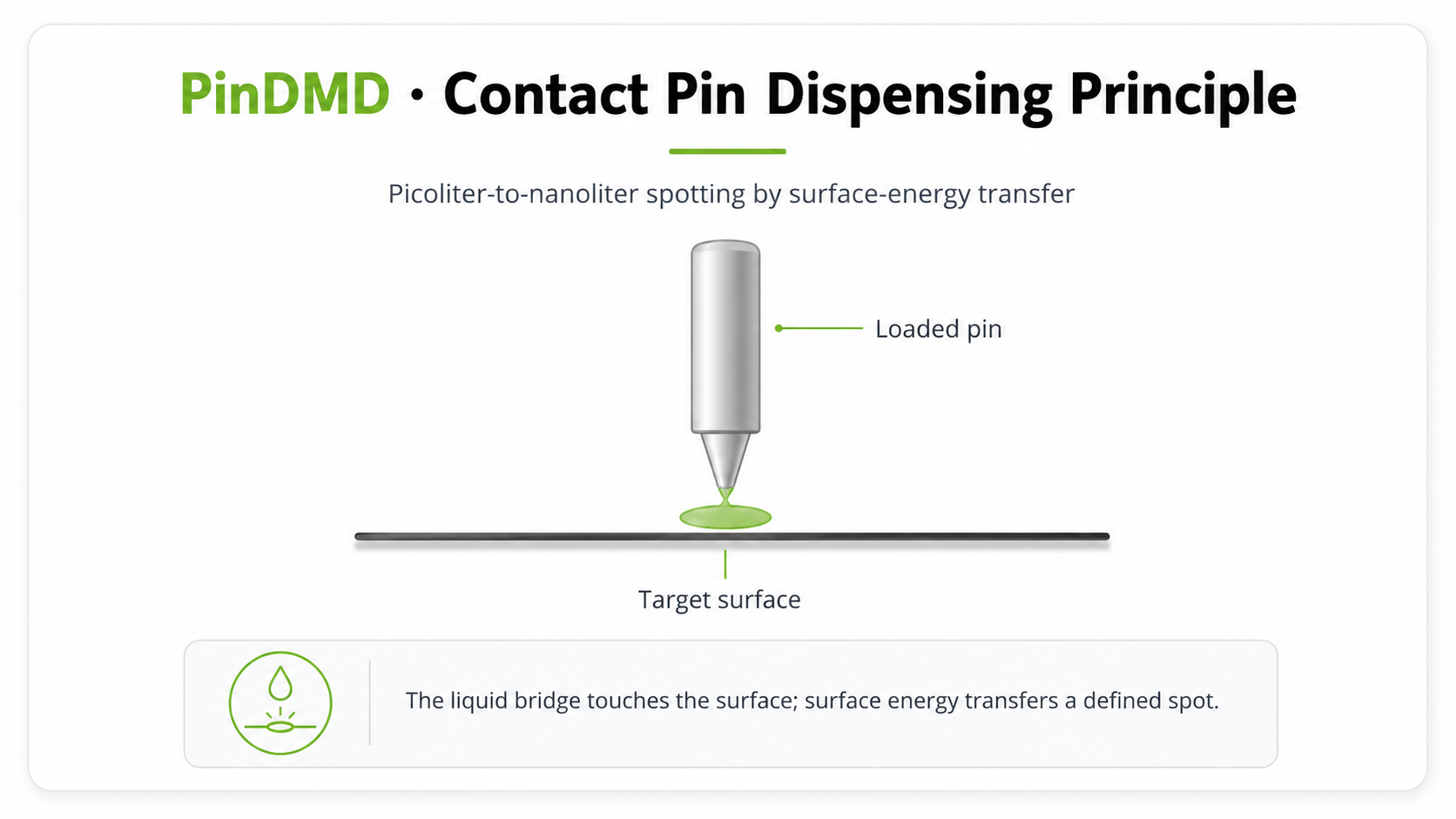
Unlike non-contact microdispensing methods, a contact pin does not eject a free-flying droplet. A pin loaded with liquid is lowered until the liquid at its tip touches the target surface. This creates a liquid bridge between the pin and the substrate.
A defined portion of liquid transfers to the surface according to the interaction between liquid surface tension, pin geometry, target wettability and contact conditions. After the pin retracts, the remaining liquid bridge pinches off and the deposited volume spreads to its equilibrium spot geometry.
What controls liquid transfer?
Contact pin printing is governed primarily by the balance of surface energy between the liquid, pin and target surface. A more wettable target surface can draw more liquid from the pin, while a lower-wetting surface usually limits spreading and can result in smaller spots.
Because no droplet is accelerated through a nozzle, contact-based dispensing can be suitable for liquids that are difficult to jet, including more viscous formulations, particle-containing samples and selected chemically demanding liquids. The trade-off is that the pin touches the substrate, which needs to be considered for fragile coatings, sensitive membranes and delicate surface structures.
A pin-driven microdispenser uses controlled pin movement to transfer liquid to the target by contact. The pin acts as a liquid carrier rather than an active jetting element. The final spot is determined by pin design, liquid properties, target surface behaviour and process settings.
A liquid-loaded pin approaches the target surface until a liquid bridge is formed. Surface energy transfers part of the liquid to the target. When the pin retracts, the bridge pinches off and leaves a spot that spreads according to the surface properties of the substrate.
Two common pin geometries cover a wide range of contact-printing workflows. The right choice depends on target volume, required spot density, source liquid properties, cleaning requirements and the number of spots required from each loading cycle.
Pin types
Capillary pins
Capillary pins retain liquid in an internal channel. They can transfer multiple spots from a single loading step and are therefore useful for high-density arrays, repeated spotting patterns and applications where many features must be deposited efficiently.
Blunt-end or solid pins
Blunt-end pins carry liquid on a flat tip. Their geometry can simplify cleaning and can be useful for robust repeated transfer processes. The transferred volume depends strongly on the tip size, the liquid bridge and the wetting behaviour of the target surface.
Spot fromation
Spot formation is a controlled sequence. Each stage can affect the final deposited volume, spot diameter, roundness, edge definition and consistency across an array.
Loading
The pin is dipped into the source liquid. Depending on pin design, liquid is drawn into an internal capillary channel or retained on the pin tip through capillarity and surface tension.
Approach and contact
The pin moves toward the target until the liquid at the tip contacts the surface. A liquid bridge forms between the pin and substrate.
Transfer
Surface energy transfers a portion of the liquid from the pin to the target. The transferred volume is influenced by pin-tip geometry, surface wettability, liquid viscosity, surface tension and contact conditions.
Pinch-off and spread
The pin retracts and the liquid bridge separates. The transferred liquid remains on the substrate and spreads toward its equilibrium contact angle. Surface chemistry, drying conditions and liquid formulation influence the final spot morphology.
Key parameters governing spot volume
Contact pin spot volume is application-dependent. The ranges below are practical orientation values and should be validated for the actual pin, liquid, substrate and environmental conditions.
Typical spot volume
Approx. 350 pL to 25 nL
The transferred volume depends on pin-tip size, liquid retention, target wettability and the physical behaviour of the liquid bridge during contact and retraction.
Pin tip diameter
Typical range: 80 to 500 µm
Pin-tip diameter is one of the strongest physical levers for spot size. Smaller tips usually support smaller spots, while larger tips can transfer larger volumes.
Surface wettability
Defined by contact angle
More wettable surfaces generally pull more liquid from the pin and allow stronger spreading. Lower-wetting surfaces can limit liquid transfer and reduce spot diameter.
Surface tension and viscosity
Liquid-dependent
Surface tension and viscosity influence how easily liquid detaches from the pin, how stable the liquid bridge remains and how the deposited spot spreads on the target.
Dispensing different sample types
Contact pin dispensing can be useful for a broad range of samples because it does not depend on stable droplet jetting. However, liquid compatibility, pin material, cleaning strategy, substrate interaction and biological activity must still be validated for every application.
DNA and oligonucleotide solutions
Capillary pins can be suitable for high-density array printing because they can transfer many spots from a single loading step. The final process window depends on formulation viscosity, DNA concentration, target chemistry and required spot density.
Antibody and protein solutions
Contact transfer can support gentle deposition when the liquid, pin material and target surface are compatible. Activity retention depends on the full workflow, including buffer formulation, immobilisation chemistry, drying conditions and post-print treatment.
Viscous or glycerol-containing liquids
More viscous formulations can be difficult to dispense by non-contact jetting. Contact pin printing can provide a robust alternative because liquid transfer is based on surface contact rather than nozzle-level droplet formation.
Chemically demanding liquids
Contact pins can be selected in chemically compatible materials for selected solvents, acids or aggressive formulations. Material compatibility must always be checked against the full liquid composition and cleaning process.
A major advantage of contact pin printing is parallelism. Multiple pins can be mounted in one dispensing head so that a complete pattern of spots is transferred in a single touch-down. This approach can support efficient printing of high-density microarrays and multiplexed assay layouts.
Why parallel pin printing matters
Parallel pin arrays can transfer many spots at once while maintaining the geometric relationship between the features. This is especially relevant for high-density microarray printing, multiplexed assay development and applications where repeatable array geometry is important.
Contact, piezo or solenoid: matching method to application
The suitable technology depends on target volume, sample properties, substrate sensitivity, required throughput and whether physical contact with the substrate is acceptable.
| Property | Contact pin PinDMD |
Piezoelectric PDMD |
Solenoid-driven M2MD |
|---|---|---|---|
| Typical volume range | Approx. 350 pL to 25 nL | Picoliter to low nanoliter range | Nanoliter to microliter range |
| Transfer principle | Surface-energy transfer through physical contact | Acoustic pressure wave from piezo deformation | Pressurised reservoir and fast valve actuation |
| Volume control | Pin geometry, wetting and liquid behaviour | Pulse shaping and waveform parameters | Pressure, valve-opening time and liquid properties |
| Liquid tolerance | Broad, depending on pin material and target surface | Application-dependent, especially for higher-viscosity liquids | Suitable for larger volumes and selected more viscous liquids |
| Best suited for | High-density arrays and contact-tolerant substrates | Smallest non-contact spots and fine picoliter dosing | nL to µL reagent delivery and larger droplets |
| Important consideration | Physical contact can disturb fragile coatings or delicate structures | Stable jetting depends on liquid and waveform optimisation | Minimum dispensing volume is typically higher than for piezo systems |
- Microdispensing applications
- Piezoelectric microdispensing: physics, design and pulse shaping
- Solenoid-driven microdispensing: pressure, valve timing and droplet control
- Overview of M2-Automation microdispensers
The M2-Automation PinDMD supports contact-based spot transfer for selected microarray and multiplexing workflows, with pin geometry and multi-pin configurations matched to the required application.