
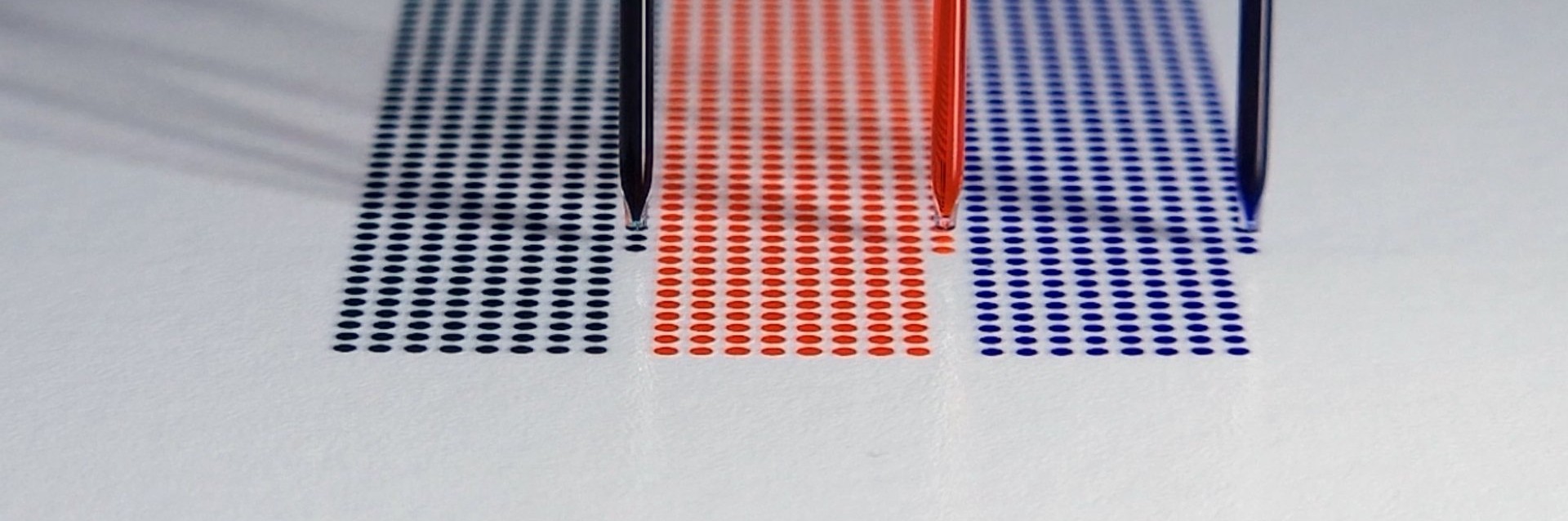
Microdispensing Applications
from Picoliters to Microliters
Microdispensing Applications from Picoliters to Microliters
Microdispensing is the controlled deposition of very small liquid volumes onto or into defined target areas. Depending on the liquid, substrate and process goal, these volumes can range from picoliters and nanoliters up to microliters.
Microdispensing technology is used when liquids need to be placed accurately, reproducibly and with minimal material consumption. Typical applications include biological microarrays, protein and peptide arrays, antigen and allergen arrays, DNA arrays, biosensors, microfluidic devices, lab-on-a-chip systems, microneedle patches, functional polymer coatings, wafers, microchips and customer-specific carriers.
The technology is especially relevant when conventional pipetting, coating, spraying or printing methods are too imprecise, too wasteful or not suitable for small, sensitive or high-value substrates.
Why microdispensing matters
Many scientific, diagnostic and pharmaceutical applications are not limited by the availability of a liquid. They are limited by the ability to place that liquid exactly where it is needed.
A droplet can define a reaction site, a capture area, a sensor coating, a drug-loaded zone, a functional layer or a diagnostic feature. Its position, volume, morphology and drying behaviour can influence the performance of the final product. In biological assays, this may affect signal intensity, background, sensitivity and reproducibility. In functional coatings or sensor applications, it may influence layer homogeneity, material distribution, response behaviour and device-to-device variation.
This is why microdispensing is not only a liquid handling step. It is often a process-defining technology.
What is microdispensing?
Microdispensing describes the precise application of ultra-low liquid volumes onto a target substrate. The liquid may contain biological capture molecules, functional polymers, drug formulations, sensor materials, hydrogel or sol-gel matrices, enzymes, cells, particles, coating materials or other application-specific formulations.
Unlike conventional pipetting, microdispensing is designed for small target areas, low sample consumption and reproducible droplet formation. Unlike many coating methods, it can apply defined volumes locally instead of covering an entire surface.
M2-Automation systems can be configured with different dispensing technologies, including non-contact picoliter dispensing, nanoliter dispensing and contact-based pin dispensing. The suitable technology depends on the required volume range, liquid properties, substrate geometry, target area, throughput and quality control strategy.
Where Microdispensing creates value
Microdispensing creates value when the liquid is precious, the target area is small, the substrate is sensitive, or the process has to be transferred from feasibility testing to repeatable production. The relevant question is rarely only “how small is the droplet?”. A more useful question is: can this liquid be deposited reproducibly onto this substrate at the required target position, volume and quality level?
This application-oriented view is important because many potential users do not search for “microdispensing” at first. They search for ways to functionalize sensors, coat microchips, load microneedles, deposit polymer solutions, print diagnostic reagents, reduce sample consumption, improve spot morphology or avoid scrap on high-value substrates.
Typical applications of microdispensing technology
Biological microarrays and multiplex assays
Biological microarrays are one of the most established applications for microdispensing. A microarray is a defined arrangement of capture molecules or biological materials on or within a solid support. Typical printed materials include antibodies, antigens, peptides, proteins, allergen extracts, DNA probes, oligonucleotides, aptamers, enzymes and cells.
The value of the microarray format is multiplexing. A single sample can be tested against many parameters in parallel. This can reduce sample consumption, reagent use, assay time and cost compared with separate single-analyte workflows. Microarrays are used in proteomics, genomics, allergen testing, infectious disease diagnostics, autoimmune profiling, biomarker discovery, drug discovery and multiplex immunoassay development.
For these applications, the printing step has to do more than create a visible spot. The printed material must remain accessible and functional during immobilisation, drying, washing, blocking, storage and final assay use. Spot position, spot morphology, deposited volume, surface interaction and drying behaviour can all affect analytical performance.
Protein, peptide, antibody and antigen arrays
Protein and peptide arrays require gentle and reproducible deposition of biological material. The liquid may contain antibodies, antigens, recombinant proteins, peptides or allergen extracts. Typical process challenges include preserving biological activity, minimizing background and maintaining consistent spot morphology.
Picoliter dispensing can be suitable for small, dense arrays. Nanoliter dispensing may be relevant for larger spots, specific formulations or applications where a higher deposited volume is required. The final process window depends on molecule type, concentration, additives, viscosity, substrate, humidity and assay readout.
For IVD-related antibody or antigen arrays, the process must also address traceability, reproducibility, missing-spot control and documented batch release criteria.
DNA, oligonucleotide and aptamer arrays
DNA and oligonucleotide arrays require controlled deposition of probes, primers, oligonucleotides or related nucleic acid materials. Key process goals include consistent immobilisation, stable hybridisation performance and reproducible spot formation. Depending on the array density, surface chemistry and readout method, different dispensing concepts may be suitable. The process should be validated with the actual liquid, substrate and downstream assay workflow.
Cell, enzyme, hydrogel and sol-gel arrays
Some array formats use cells, enzymes, lysates or other functional biological materials. These samples can be formulation-sensitive and volume-sensitive. The dispensing process must preserve viability or activity and avoid conditions that could damage the sample.
Hydrogel and sol-gel arrays add another layer of complexity. In these formats, capture molecules are embedded in a gel-like matrix rather than only coupled directly to a functionalized surface. This can be useful on polymer substrates where classical surface functional groups are limited or where background must be minimized. In these applications, gelation, diffusion, spot geometry, background control and substrate interaction must be evaluated together.
Biosensors and functional sensor surfaces
Many users who could benefit from microdispensing do not describe their application as microarray printing. They may be developing a biosensor, an ion-selective electrode, a functionalized microchip, a cantilever-based sensor, an optical detection area or a coated electrode.
In these cases, the goal is often to place a defined amount of functional material onto a very small target area. The liquid may be a polymer solution, a hydrogel precursor, an ion-selective membrane formulation, a biological receptor layer, a coating material or another functional formulation.
Microdispensing can support these workflows by applying the liquid locally, without flooding neighbouring structures and without using more material than necessary. Non-contact dispensing is particularly relevant when the substrate is sensitive, expensive, structured or difficult to access.
Microfluidic devices and lab-on-a-chip systems
Microfluidic and lab-on-a-chip devices often contain small channels, cavities, reaction zones, detection areas, membranes or structured surfaces. These areas may need to be functionalized with biological material, reagents, coatings, polymers or sensor chemistries.
COP, PP and other polymer substrates are relevant for lab-on-a-chip, IVD cartridges and optical polymer components. Silicon, wafers and microchips are relevant for biosensors, high-value chips and lab-on-a-chip applications, where precise positioning and fiducial alignment are critical.
For these applications, the substrate is not just a carrier. It determines how the liquid spreads, dries, reacts, immobilises or remains confined. Cleaning, activation, surface energy, electrostatic effects and background control can all influence the final result.
Microneedle patches and drug delivery formats
Microneedle patches are a strong example of an application where precise local deposition can create value beyond classical assay printing. Active ingredients, polymer formulations or functional coatings may need to be applied to very small and often three-dimensional target structures.
Microdispensing can be used to load individual microneedles, coat microneedle tips, apply drug formulations to defined zones or create reproducible deposition patterns on structured patch surfaces.
The key challenge is the combination of dose control, formulation behaviour and target geometry. The liquid may contain active pharmaceutical ingredients, excipients, polymers or stabilizers. Its viscosity, drying behaviour and interaction with the microneedle material must be tested under realistic process conditions.
Polymer solutions and functional coatings
Not every microdispensing process involves an easy aqueous buffer. Many applications require the deposition of liquids that are difficult to print or handle. These may include polymer solutions, viscous formulations, solvent-containing materials, hydrogels, sol-gel systems, ion-selective membrane formulations or coatings with functional additives.
In these applications, the goal may be a homogeneous thin layer, a permeable coating, a defined reaction zone or a localized functional material deposit. Additives such as glycerol, sugars, salts, surfactants, betaine or polymers can improve spot morphology, stability or drying behaviour, but they can also interfere with immobilisation or final performance. They should therefore be treated as formulation tools, not as universal recommendations.
High-value substrates, wafers and microchips
Microdispensing is especially useful when the substrate is expensive, difficult to replace or already contains high-value structures. Examples include wafers, silicon chips, microchips, biosensor carriers, optical components, diagnostic cartridges and lab-on-a-chip devices.
In these cases, avoiding scrap can be as important as achieving high throughput. A controlled recovery concept can help when unstable droplet formation or missed features are detected by pre-spot QC or in-line monitoring. The affected positions can be tracked and handled through a documented reprinting workflow after the cause has been corrected. The value lies in controlled exception handling instead of silent process continuation.
Substrates and target surfaces for microdispensing
The substrate is not only a physical support. It determines how the liquid spreads, remains confined, reacts with the surface, dries, immobilises or creates background. A successful microdispensing process therefore requires a match between liquid, surface, matrix and final application.
| Substrate or format | Typical use | Main process point |
|---|---|---|
| Aldehyde, epoxy or NHS-ester glass | Protein, antibody, antigen, peptide or selected DNA arrays | Surface chemistry, reaction time, humidity, blocking and washing conditions must be validated. |
| Nitrocellulose membrane | Lateral flow, dot blot and membrane-based assays | Lot variation, swelling and humidity sensitivity can affect spot geometry. |
| MTP well bottom or plastic | ELISA-format multiplexing, screening and optical readout | Optical, high-binding, low-binding or non-binding bottoms must be selected according to the assay. |
| COP, PP and other polymer substrates | Lab-on-a-chip, IVD cartridges and optical polymer components | Surface cleaning, activation, wettability and background control are critical. |
| Silicon, wafers and microchips | Biosensors, high-value chips and lab-on-a-chip components | Small target areas require precise positioning and fiducial alignment. |
| Microneedles and three-dimensional patch structures | Drug delivery, coating and localized loading | Geometry, dose control, drying behaviour and formulation stability must be evaluated together. |
Liquids and formulations suitable for evaluation
Microdispensing can be used with many different liquid classes, but there is no universal guarantee for every liquid or every formulation. The process window depends on liquid properties, target volume, dispenser type, substrate and environmental conditions.
Relevant material classes include biomolecules such as proteins, antibodies, antigens, allergens, peptides, enzymes, DNA probes, oligonucleotides and cells. They also include hydrogel and sol-gel formulations, polymer solutions, functional coating materials, drug formulations, active ingredients, sensor materials and ion-selective coating systems.
For biological materials, the key question is whether activity or viability is preserved after dispensing and subsequent processing. For functional materials, the key question is whether the deposited structure, layer or coating delivers the required final performance.
What determines a successful microdispensing process?
Liquid properties
The liquid defines whether stable droplet generation is possible. Relevant factors include viscosity, surface tension, concentration, particle load, solvent system, additives, biological stability and drying behaviour. Sensitive molecules may require gentle handling. Particle-containing or aggregate-prone liquids may require validated clarification steps that do not damage or deplete the active material.
Substrate properties
The substrate defines how the droplet behaves after deposition. Surface energy, chemistry, roughness, geometry, wettability, functionalization and electrostatic behaviour can influence spreading, confinement, immobilisation and background. Deionisation may be relevant before printing to reduce electrostatic effects and particle attraction.
Environmental conditions
Humidity and temperature are not universal settings. Humidity can influence surface chemistry, droplet formation, spot spreading, drying behaviour, sample stability in the source plate and immobilisation kinetics. Higher humidity may support spot formation for some aqueous protein buffers, while lower humidity may be required for selected polymer surfaces, moisture-sensitive chemistries or applications where excessive spreading must be avoided.
The relevant process parameter is a validated humidity window for the specific assay, material or substrate. During long production runs, constant humidity and temperature help stabilize source plate conditions and reduce drift in droplet behaviour.
Application-specific validation
Volumetric ranges, spot diameters, humidity values and acceptance limits should not be treated as universal specifications. They must be verified with the actual liquid, substrate, target geometry and readout. This is especially important when transferring a process from feasibility testing to production.
Spot, coating and layer quality
Spot or coating quality has several independent dimensions: morphology, position accuracy, deposited volume, absence of satellites, absence of cross-contamination, immobilisation efficiency, biological activity and compatibility with downstream process steps. A visually round spot alone is not sufficient if the capture molecule loses activity, if washing causes smearing or if the final sensor or device does not perform as required.
One common failure mode is the coffee-ring effect. This describes ring-shaped or inhomogeneous drying, where material is transported toward the edge of the drying droplet. Buffer composition, surface energy, humidity, drying rate and droplet volume can all influence this behaviour.
Non-contact dispensing can help by generating defined droplets and avoiding mechanical contact with the substrate. It also reduces carry-over risks that can be associated with contact tools. However, non-contact dispensing still requires validated liquid properties, pulse parameters and environmental conditions to avoid satellites, unstable droplets or excessive spreading.
For biological applications, the printed molecule must remain functional after dispensing, immobilisation, drying, washing, blocking, storage and assay use. For functional materials, the deposited layer or structure must meet the required performance criteria after drying, curing, reaction or integration into the final device.
Non-contact and contact dispensing options
Non-contact dispensing means that droplets are ejected from the dispenser without the nozzle, pin or tool touching the substrate. This can reduce mechanical interaction with sensitive surfaces, decrease carry-over risk and support precise deposition onto small, structured or high-value target areas.
Contact-based pin dispensing can still be useful for selected applications, materials or layouts. The right dispensing principle depends on the liquid, target volume, substrate, throughput, acceptable contact risk and required process robustness. M2-Automation systems can be configured with different dispenser types so that the process can be adapted to the application rather than forcing the application into one dispensing concept.
Quality control and process documentation
For production-oriented microdispensing, quality control should combine pre-spot liquid testing, in-line camera monitoring, documented print logs and downstream verification methods adapted to the material and application. A robust process should define what is checked before printing, what is monitored during printing and how the final printed substrate is released.
Pre-spot droplet testing can confirm stable droplet generation before production. Camera-based monitoring can help detect droplet instability, missing features or position deviations during the run. Print logs can document timestamps, coordinates, sample IDs, parameters and QC flags.
Downstream verification depends on the application. In some workflows, printed features are visible or can be checked by suitable marker systems. In others, fluorescence scanning or another readout method is part of the final assay evaluation rather than direct QC of an unlabelled printed array. Acceptance criteria should therefore be defined for the specific process and final product.
For regulated or production-relevant workflows, it is important to distinguish between instrument-related dispensing reproducibility, printed spot geometry and final biological or functional performance. These are not the same metric and should not be communicated as if one universal CV value described the entire process.
A practical workflow for microdispensing process development
A microdispensing project often starts with one practical question: can this liquid be deposited reproducibly onto this substrate at the required target position and volume? From there, the process should be developed step by step.
| Process step | Purpose | Practical focus |
|---|---|---|
| 1. Liquid and formulation assessment | Prepare a printable and application-compatible sample. | Evaluate concentration, viscosity, additives, stability and compatibility with the final readout or device function. |
| 2. Gentle sample handling | Reduce particles and aggregates without damaging the material. | Use validated clarification, filtration or handling methods. Do not assume every biological sample is centrifugation-robust. |
| 3. Substrate preparation | Create a clean, reproducible target surface. | Consider cleaning, dust removal, plasma treatment, activation and deionisation where relevant. |
| 4. Environmental equilibration | Stabilize substrate and liquid conditions. | Equilibrate source plates, substrates and chamber conditions to the validated temperature and humidity window. |
| 5. Dispenser setup and liquid test | Confirm stable droplet generation before production. | Use droplet observation or camera-based testing and record liquid and parameter data. |
| 6. Layout and positioning strategy | Define reproducible target positions and controls. | Define spacing, replicates, printing order, fiducials, calibration positions and QC features. |
| 7. Printing with monitoring | Deposit material while detecting process deviations. | Monitor droplet stability, spot presence and position where the system supports it. |
| 8. Post-print handling | Allow immobilisation, adsorption, gel formation, drying, curing or reaction. | Validate the required time, humidity, temperature and storage conditions for the application. |
| 9. Blocking, washing or integration | Prepare the printed substrate for assay use or final device integration. | Match blocking, washing and storage to the surface, material and performance goal. |
| 10. Quality verification | Release only substrates that meet defined criteria. | Use appropriate in-process and downstream verification methods with documented release criteria. |
How to start a microdispensing feasibility study
The most useful starting point is not a generic volume specification. It is the application context. To evaluate a microdispensing process, M2-Automation application specialists typically need information about the liquid, substrate, target area, desired volume, pattern, environmental sensitivity, required throughput, QC expectations and production goal.
Useful information includes the formulation type, solvent system, viscosity range, particle or biomolecule content, substrate material, surface treatment, target geometry, desired deposited volume, spot or coating dimensions, acceptable variation and downstream process steps. This information helps identify the most suitable dispenser, system configuration and feasibility testing approach.
From feasibility testing to production
A common scaling risk is developing a method on one system and later discovering that the production platform creates different spot geometry, drying behaviour or biological performance. To reduce this risk, relevant print parameters, dispenser type, environmental conditions, layout logic and QC strategy should transfer from feasibility to production wherever possible.
For production, the process must go beyond successful single tests. It should define acceptable limits for droplet stability, spot presence, position accuracy, spot size, QC flags, traceability and final performance. For high-value substrates, controlled recovery workflows can reduce avoidable reject material by documenting and addressing missed features instead of silently continuing the run.
M2-Automation systems for microdispensing applications
M2-Automation supports different stages of development and production. The platform choice depends on the application stage, substrate format, required throughput, automation level and QC concept.
Discover Microdispensing Systems
Dispenser selection is application-specific. The right choice depends on target volume, liquid properties, substrate and production requirements.