Diagnostic Membrane (Closeup)

Technical knowledge hub

Piezoelectric, solenoid-driven and contact pin microdispensing

Technical guides for microdispensing principles

Microdispensing performance depends on more than target volume. The physical dispensing principle, liquid properties, substrate behaviour, geometry and process control all influence droplet formation, spot quality and reproducibility.

These technical guides explain the three core microdispensing principles used across the M2-Automation portfolio: piezoelectric dispensing, solenoid-driven dispensing and contact pin printing. Each guide focuses on the underlying physics, relevant process parameters, practical limitations and suitable application areas.

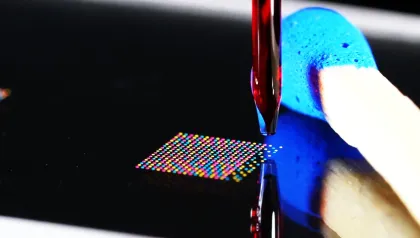
PDMD - spotting a high-density microarray of picoliter droplets using a piezo dispenser next to a match to show the miniaturisation

Piezoelectric Microdispensing

Learn how piezo actuator deformation, pressure wave propagation, nozzle geometry and pulse shaping generate stable droplets in the picoliter range.

The guide covers the inverse piezoelectric effect, Rayleigh-Plateau breakup, waveform optimisation, satellite suppression and stroboscopic droplet monitoring.

Explore piezoelectric microdispensing

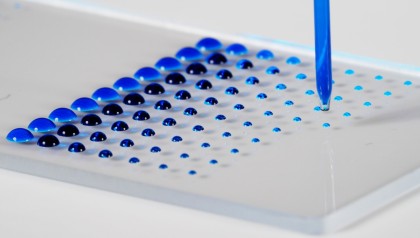
printing a micro array of nanoliters droplets on a glass surface using an microdispenser to show the big volume range

Solenoid-Driven Microdispensing

Understand how reservoir pressure, valve-opening time, nozzle geometry and fast solenoid actuation control non-contact liquid delivery from nanoliters to microliters.

The guide explains the two operating regimes of solenoid valve dispensing, parameter selection, liquid behaviour and practical process optimisation.

Explore solenoid-driven microdispensing

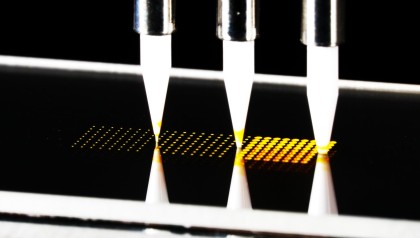
contact spotting of a high density array on a glass slide with different sizes of pins using a pin spotter

Contact Pin Microdispensing

Explore how loaded pins transfer liquid to a target surface through controlled contact, surface energy, wettability and pin-tip geometry.

The guide covers capillary and blunt-end pins, liquid bridge formation, spot transfer, surface interaction and high-density parallel printing.

Explore contact pin microdispensing

Three dispensing principles, different process windows

No single dispensing technology is universally suitable. The right approach depends on the required volume range, liquid viscosity, surface tension, substrate sensitivity, target geometry, throughput and whether physical contact with the substrate is acceptable.

Piezoelectric Microdispensing

Transfer principle
Piezo-driven pressure wave
Primary control parameters
Waveform, pulse amplitude and nozzle geometry
Typical strength
Fine non-contact picoliter droplets and precise spot placement
Important consideration
Stable jetting depends on liquid properties and waveform optimisation


Solenoid-Driven Microdispensing

Transfer principle
Pressurised reservoir and fast valve actuation
Primary control parameters
Pressure, valve-opening time and nozzle geometry
Typical strength
Flexible delivery of larger droplets from nanoliters to microliters
Important consideration
Minimum dispensing volumes are typically higher than with piezoelectric dispensing

Contact Pin Microdispensing

Transfer principle
Surface-energy transfer by physical contact
Primary control parameters
Pin geometry, wetting behaviour and contact conditions
Typical strength
Robust transfer, broad liquid compatibility and high-density parallel spotting
Important consideration
Physical contact may not be suitable for delicate coatings or sensitive surface structures

From physical principle to application

The technical guides explain the physical mechanisms behind each dispensing technology. For product-specific information, including available configurations, technical specifications and application support, visit the respective microdispenser pages.


Discuss your dispensing challenge

Choosing a dispensing technology starts with the application. Share your target volume, liquid properties, substrate, spot geometry and throughput requirements with the M2-Automation team.

Discuss your application     Explore Microdispensers