
Technical Guide
From valve timing to nanoliter droplets
Solenoid Valve Microdispensing: Physics and Flow Regimes
Solenoid valve microdispensing uses a pressurised reservoir, a fast electromagnetic microvalve and defined nozzle flow to generate reproducible droplets in the nanoliter-to-microliter range.
This technical guide explains how reservoir pressure, valve-opening time, nozzle geometry, liquid viscosity and dispensing mode interact in non-contact nanoliter dispensing. It also describes the two main flow regimes, typical sample considerations and the role of aspirate-dispense and bulk reservoir configurations.
The principle: pressurised reservoir and fast valve
A solenoid valve dispenseris based on a mechanically straightforward principle. The liquid is held in a reservoir under a defined pressure. Between the reservoir and the nozzle sits a fast electromagnetic microvalve. When a current pulse energises the valve coil, the valve opens for a controlled time and pressurised liquid flows through the nozzle.
When the valve closes, the flow stops. The dispensed volume depends mainly on two controllable parameters: reservoir pressure and valve-opening time. The liquid, nozzle geometry and target substrate determine how this liquid volume forms, detaches and behaves after impact.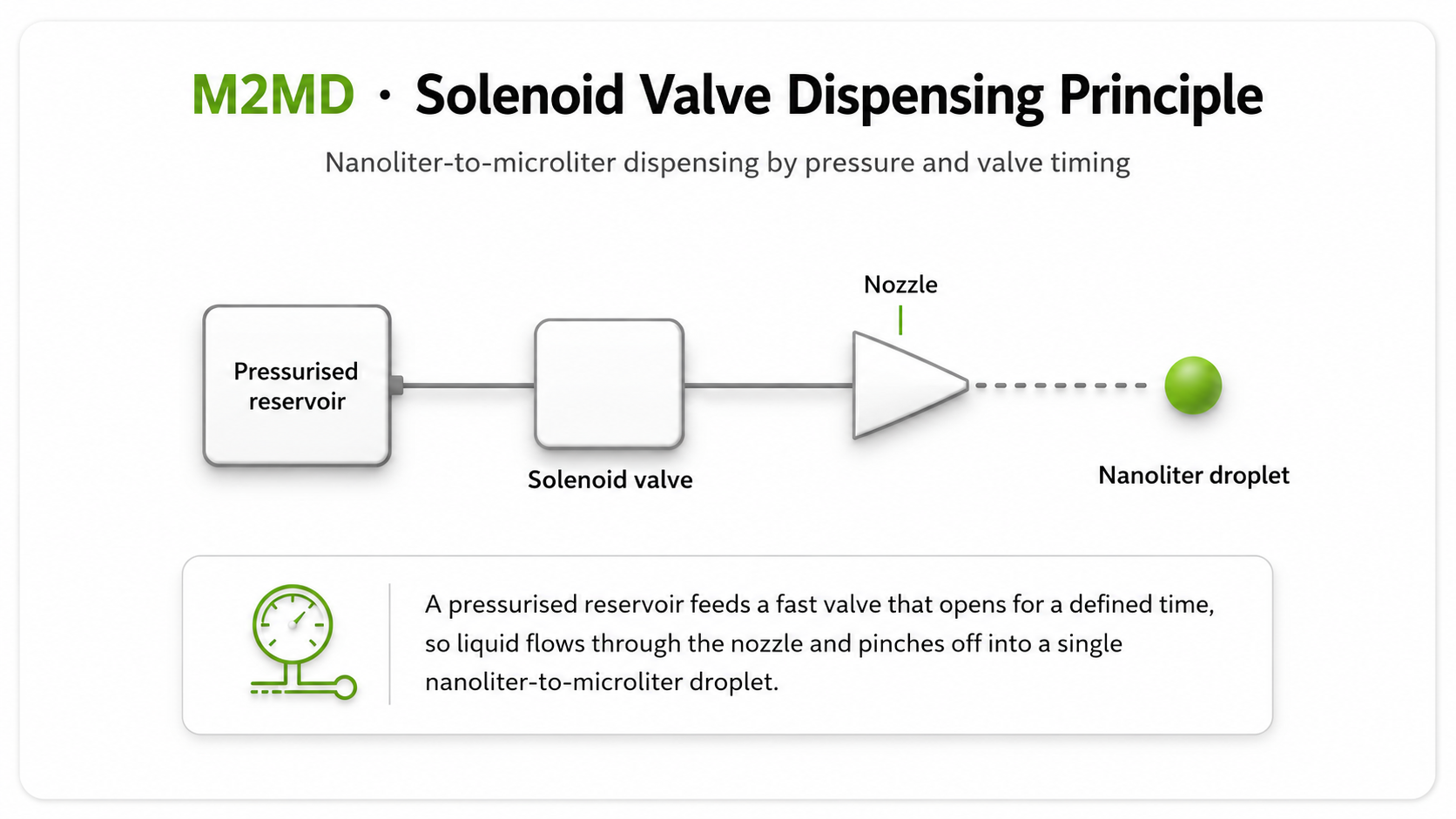
Two regimes, one valve
Solenoid valve microdispensing can operate in two related regimes. At smaller volumes, fast valve actuation and displacement effects dominate the delivered volume. At larger volumes, pressure-driven flow during a longer valve opening increasingly contributes to the dispensed amount.
This two-parameter control, combining pressure and valve-opening time, is a defining feature of solenoid-driven nanoliter-to-microliter dispensing.
M2MD solenoid valve dispensing principle
The M2MD is a non-contact nanoliter microdispenser based on pressure and valve timing. A pressurised reservoir feeds a fast solenoid valve. The valve opens for a defined time, liquid flows through the nozzle and the liquid column pinches off into a droplet.
Flow physics and key parameters
Whether the liquid leaves the nozzle as a clean droplet or as an unstable jet depends on the balance between inertial, viscous and surface-tension-related forces. Nozzle diameter, reservoir pressure, valve-opening time and liquid viscosity together define this process window.
A wider nozzle and higher reservoir pressure can increase flow rate. Higher viscosity can dampen the flow and may require higher pressure or a modified nozzle configuration. The goal is to tune these parameters so the liquid pinches off as a defined droplet instead of forming satellites, tails or excessive splashing on impact.
Single-droplet volume
Typical M2MD range: 10 nL to 5 µL
The M2MD covers small nanoliter spots as well as microliter deliveries. Larger volumes can be generated by longer valve openings or repeated dispensing events, depending on the application.
Reservoir pressure
Tunable process parameter
Reservoir pressure drives the flow rate through the nozzle. Higher pressure can support more viscous liquids or larger volumes. Lower pressure can reduce impact velocity, spreading and splashing.
Valve-opening time
Sub-ms to application-specific range
Short opening times are used for small nanoliter shots. Longer openings allow more pressure-driven flow and can be used for larger nanoliter-to-microliter droplets.
Nozzle diameter
Defined by dispenser geometry
Nozzle diameter influences flow resistance, minimum stable droplet size and clogging sensitivity. Wider nozzles can improve tolerance for higher viscosity liquids, particles or suspensions.
Liquid viscosity
Handled by pressure and geometry
Solenoid valve dispensing can accommodate a broader range of liquid behaviour than picoliter piezo jetting in many applications. Final suitability depends on viscosity, surface tension, nozzle geometry and target requirements.
Dispensing frequency
Application-dependent
Dispensing frequency depends on target volume, valve dynamics, refill behaviour, liquid properties and required reproducibility. Higher speed must be balanced against droplet stability and placement quality.
Two control parameters, two flow regimes
In piezoelectric dispensing, the defining control element is the pulse shape. In solenoid valve microdispensing, the defining control elements are reservoir pressure and valve-opening time.
These two parameters determine how much liquid passes through the nozzle during each dispensing event. At smaller nanoliter volumes, fast valve actuation and displacement effects dominate. At larger volumes, pressure-driven flow during a longer valve opening becomes more important.
This is why the same M2MD hardware can support both small nanoliter spots and larger microliter deliveries. The process window is defined by balancing pressure, opening time, nozzle geometry, liquid viscosity and target behaviour.
Reservoir pressure
Effect on volume: Defines the flow rate while the valve is open.
Optimisation target: Increase pressure for more viscous liquids or larger droplets. Reduce pressure when impact velocity, spreading or splashing must be limited.
Valve-opening time
Effect on volume: Defines how long liquid flows through the nozzle during one dispensing event.
Optimisation target: Use short openings for smaller nanoliter volumes. Use longer openings when pressure-driven flow is needed for larger nanoliter-to-microliter deliveries.
Small-volume regime
Physical behaviour: Fast valve actuation and displacement effects dominate the smallest practical volumes.
Optimisation target: Focus on clean droplet pinch-off, low satellite formation and reproducible nanoliter droplets.
Pressure-flow regime
Physical behaviour: At larger volumes, pressure-driven flow during the valve opening increasingly determines the delivered volume.
Optimisation target: Balance flow rate, droplet detachment, target wetting and impact behaviour.
Dispensing different sample types
Solenoid valve dispensing can be adapted to different liquid classes by changing pressure, valve-opening time, nozzle geometry and reservoir configuration. The examples below are starting points for method development. Actual process settings must always be verified experimentally because real sample composition, substrate wettability and environmental conditions vary.
Water and aqueous reagents
Water-like reagents are often suitable across a broad nanoliter-to-microliter range. They typically require moderate pressure and stable valve timing, but evaporation and substrate wetting should still be monitored.
Salt and reagent buffers
Concentrated buffers can change viscosity, surface tension and crystallisation behaviour at the nozzle. Stable operation may require pressure adjustment and attention to nozzle condition during longer runs.
Antibody and protein solutions
Protein-containing liquids may require gentler conditions to reduce sample stress and preserve activity. Lower pressure, suitable nozzle geometry and compatible buffer formulation can be relevant.
Viscous reagents
More viscous reagents may need higher reservoir pressure or a wider nozzle to support stable flow and droplet detachment. Suitability depends on the formulation and target volume.
Suspensions and loaded liquids
Suspensions require homogeneous particle distribution and suitable nozzle dimensions. Fine nozzles can increase clogging risk when particles, beads or cell-like structures are present.
Wash and dilution steps
Bulk reagent feed can support repetitive dispensing of the same liquid across many target positions. This is useful for workflows where a single reagent must be dispensed many times.
Dispensing modes and motion
Solenoid valve dispensing is well suited for nanoliter-to-microliter liquid handling because it combines robust valve actuation with adjustable pressure and flexible reservoir configurations. How the dispenser moves relative to the target determines both speed and placement strategy.
In aspirate-dispense mode, the dispenser draws up a defined amount of liquid and places nanoliter portions onto target positions. This mode is useful when sample volume is limited, when dead volume should be minimized or when different liquids must be handled individually.
In bulk mode, a larger reservoir or vial supplies the dispenser with a continuous reagent feed. This mode is suitable for high-count workflows with one liquid, for example repeated reagent dispensing across many target positions or larger liquid delivery tasks.
Related reading
Learn more about related microdispensing technologies, application areas and instrument selection.
- M2MD technical details for non-contact nanoliter-to-microliter dispensing
- Piezoelectric microdispensing: physics and pulse shaping
- Overview of M2-Automation microdispensers
- Microdispensing applications from picoliters to microliters
- Microdispensing instrument guide
See the M2MD nanoliter dispenser in action
M2-Automation M2MD technology combines pressure-based liquid delivery, fast valve timing and flexible reservoir configurations for nanoliter-to-microliter dispensing workflows.